

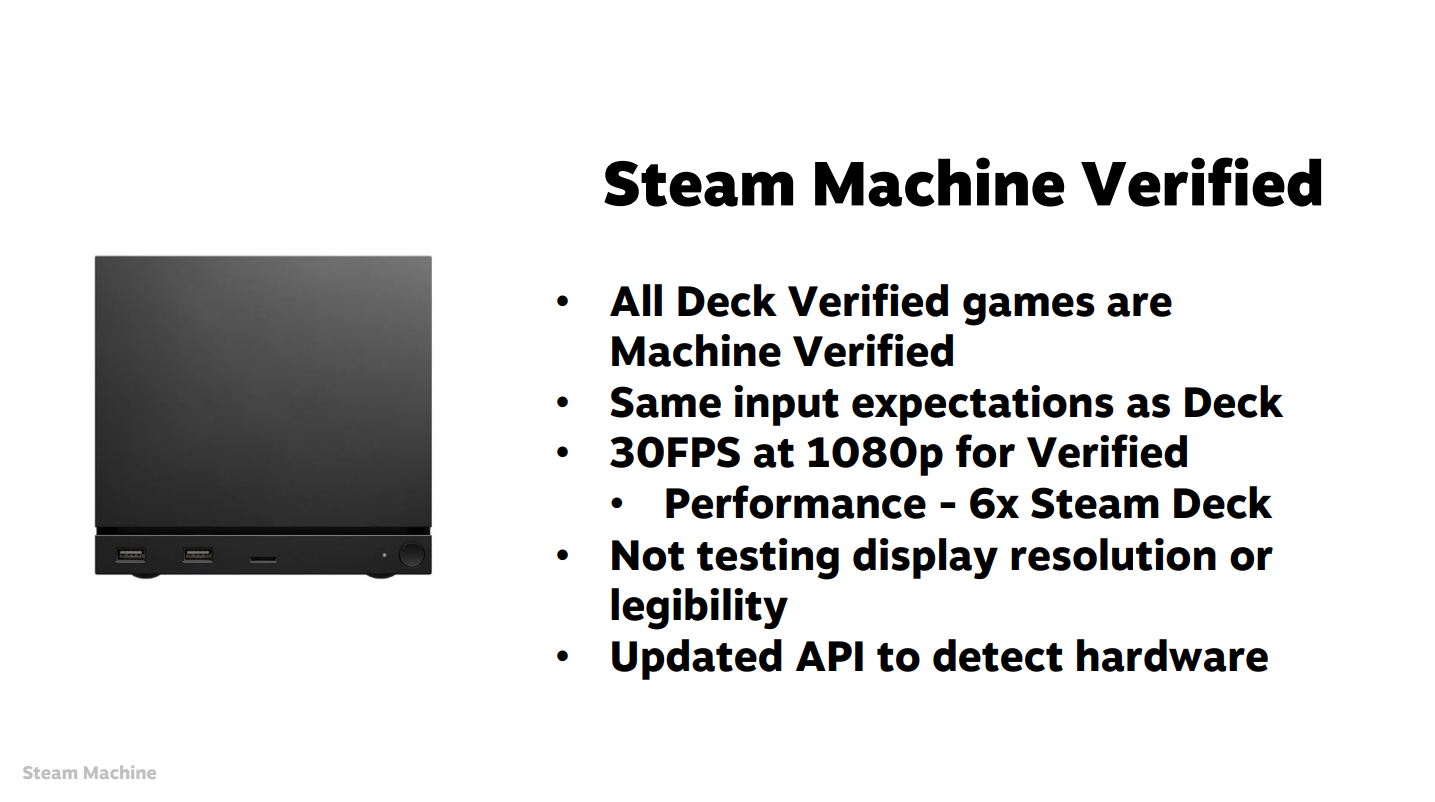
Valve: to get certification for Steam Machine, the game must deliver 30 fps at 1080p
At the Game Developers Conference in San Francisco, Valve told developers what they’ll need to do to get games certified for upcoming SteamOS devices. The talk covered two pieces of hardware: a Steam Machine-style console and the Steam Frame VR headset — and yes, some Steam usage stats slipped into the slides as well.
The Steam Machine rules are straightforward: if your title already has Steam Deck compatibility, it’s nearly in by default. There’s one extra bar though — the game must reach at least 30 fps at 1080p. Valve didn’t bring up upscaling or frame-generation tech, so this reads as a native-performance requirement (i.e., not relying on tricks).
Controller handling follows the Steam Deck pattern; no new button-mapping surprises. UI legibility and strict resolution rules? Not enforced — Valve seems to assume people will hook these boxes to a monitor or TV instead of squinting at a tiny built-in display.
The Steam Frame headset behaves differently depending on how the game runs. Streamed PC titles don’t need a separate cert, but standalone apps running on the built-in ARM chip do have to hit performance targets. For VR content that means 90 fps; simple 2D apps must hold 30 fps at 720p — so devs should pay attention to the ARM performance envelope, e.g., budget for optimization.
In the slide deck Valve reminded teams of SteamOS development basics: support offline use (first launch included), optimize for lower-end hardware, and make gamepad controls robust. They argue this widens potential reach, though whether every studio will follow that advice remains to be seen.
Steam metrics
Besides hardware, Valve also talked about Steam’s numbers — and the headline was that more titles are clearing meaningful revenue thresholds.
In 2025, 5,863 games made over $100,000. For perspective, five years earlier the count was just above three thousand. It’s a big jump; take it as a sign that money is spreading across more projects, not necessarily that every release is a breakout hit.
Addressing concerns about store crowding, Valve described the store algorithm’s aim as “to show the right game to the right player.” One mechanism is the daily-discount sales: roughly 1,500 projects took part last year, and 69% of those were in such sales for the first time.
Player spending also rose. About 8.2 million people bought at least one game during the daily sales period — up roughly 125% year-over-year. The presentation included a world map of Steam distribution too: some regions are denser than others, but users exist pretty much everywhere the platform runs.
And in a lighter moment, the team joked about a global RAM shortage affecting hardware builds. If anyone “has access to large batches of RAM,” Valve said, they’re happy to buy — which felt equal parts earnest and a developer-room punchline.