

Opera Launches Digital Archive Web Rewind for Browser's 30th Anniversary
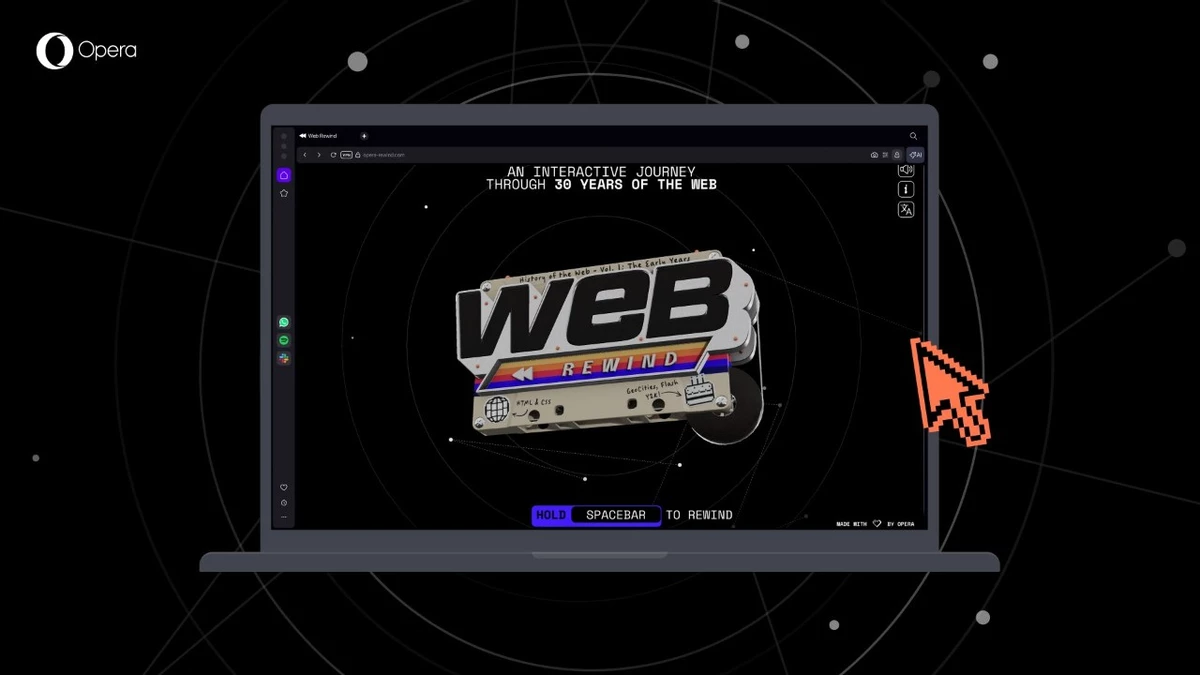
Opera has introduced the interactive portal Web Rewind — a digital archive dedicated to the history of the internet's development. The project launch coincides with the browser's 30th anniversary, which will be celebrated in 2026.
The portal is built on a chronological principle and covers the period from 1995. Users can navigate the timeline and explore key events and technological stages of the network's evolution — from the era of dial-up connections and floppy disks to the emergence of major online platforms and modern services.
The archive reflects iconic milestones of the digital era, including the launch of the Google search engine, the rise of the MySpace social network, the emergence and development of Twitter, as well as the evolution of web technologies — from HTML 3.2 to modern frameworks — and changes in the design and functionality of user interfaces.
The main feature of Web Rewind is its interactivity. Most objects in the archive don't just illustrate the past but allow interaction with them. For example, in the 1995 section, portal visitors can press keys on a virtual keyboard, move a computer mouse, rotate a model of a PC from that time, and examine in detail the hardware and peripheral devices of the era when the mass internet was born.
This approach turns studying internet history into an engaging immersion: users are not limited to reading dry facts but literally "touch" past technologies, reproduce typical actions of people from those years, and feel the spirit of the time through direct interaction with virtual artifacts.
Opera emphasizes that the project's goal is to visually demonstrate the large-scale technological transformation of the internet over three decades. Web Rewind also shows the contribution browsers have made to shaping the modern digital environment: from the modest capabilities of early versions to the multifunctional tools that have become an integral part of our daily lives.
The portal is available to all users for free. It can interest both IT professionals, for whom seeing the historical perspective of technology development is important, and a broad audience — those who want to remember or learn for the first time how the internet has changed over the last 30 years.