

Inside Burn With Me — The Demonology of Deckbuilding
When thinking about deckbuilding games, it's hard not to steer the conversation towards roguelikes. Giants like Slay the Spire, Monster Train, Inscryption, and now Balatro have cemented the feeling that the roguelike format best unlocks the potential of card games. It's hard to disagree with this, as looking at Steam statistics today, a good half of deckbuilding games are made in a roguelike format one way or another. To stand out against such a large number of similar games, a familiar formula is no longer enough – a game needs its own unique face. And Burn With Me has it! It's a narrative deckbuilder about an occult university where you need to arrange cards in the shape of a pentagram to summon demons. It's being developed by the domestic team Nozomu Games, which previously released Robot Detour – a cute puzzle game about a robot.
The Card Pentagram
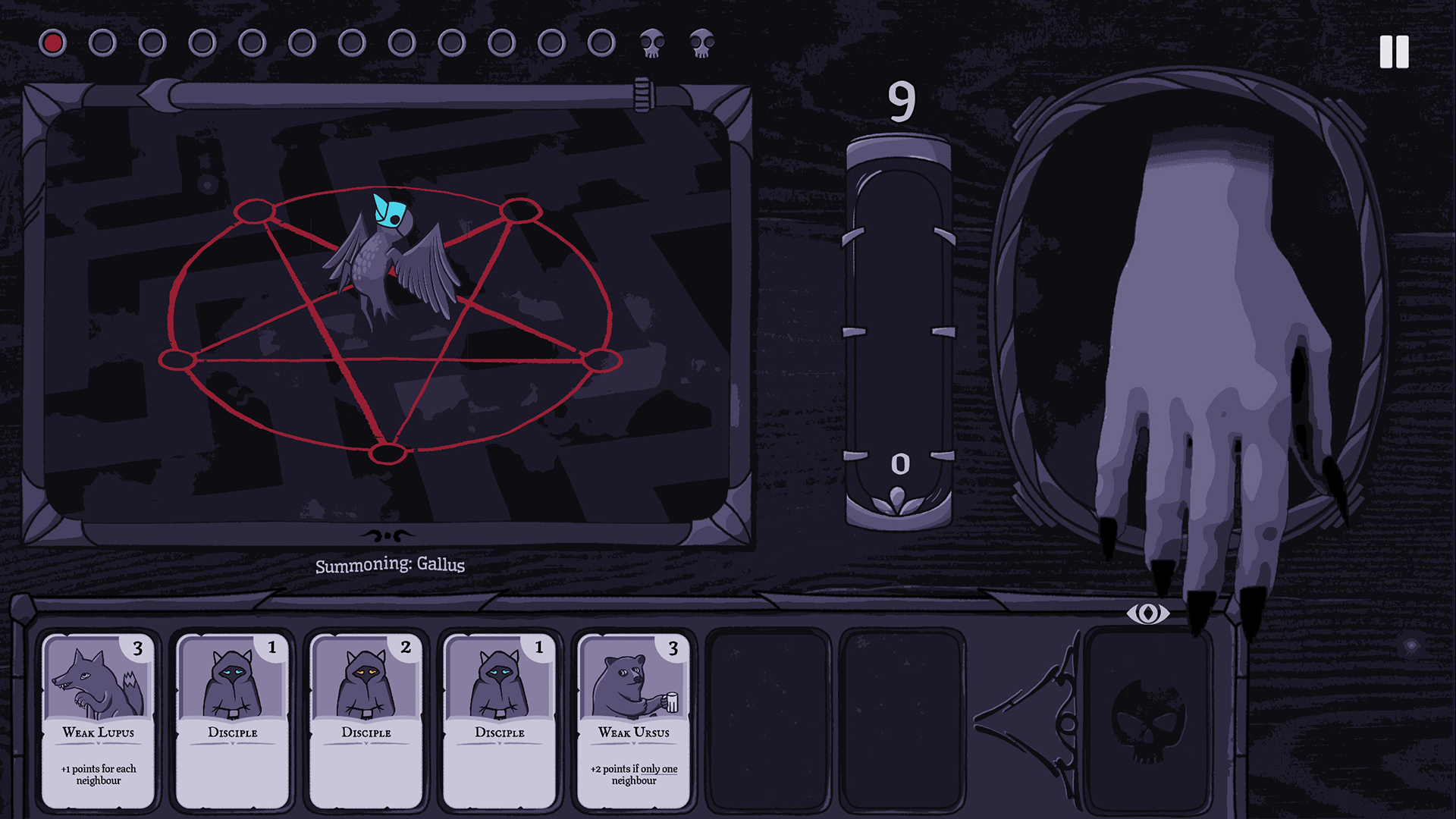
Cards must be placed around the pentagram to score the required number of points. Source: Burn With Me video game
One of the key remaining problems with collectible card games is the high barrier to entry. Memorizing a large number of cards and their effects, as well as effectively applying synergies, can take dozens of hours, which significantly narrows the potential audience and makes the genre less accessible to new players. Against this backdrop, the simplicity and elegance of Burn With Me's concept deserves special praise. From the first glance at the screenshots, it's immediately clear what the game requires of you: assemble a pentagram of five cards on the screen and gather enough blood to summon a demon. If you fail to summon the demon, you have to start the entire run from the beginning. Overall, the basic principles of the game are extremely simple, and even a player not very familiar with the CCG genre can get the hang of Burn With Me. However, behind this apparent simplicity lies a dark atmosphere, noticeably echoing Inscryption by Daniel Mullins – primarily through the card sacrifice mechanic. Mullins himself, by the way, has already praised the game's demo, which says a lot about the project's level. Yet, despite this association, Burn With Me's card system remains completely original and does not rely on existing foundations – unlike, for example, Balatro, which built its mechanics around poker.
A card summoned during the ritual. Source: Burn With Me video game
Each card in Burn With Me has a base blood value, which it contributes when placed on the pentagram, and a unique effect that always triggers at the moment of placement. The effects themselves are quite diverse and are most often tied to adjacent cards on the pentagram. Some cards give bonus blood points if their neighbors have even or odd values; others, conversely, are strengthened if they have no one nearby; and some even automatically burn if they are not placed on the pentagram in the correct sequence. The burning mechanic is generally one of the most interesting in the game. By default, if a card burns, it is completely removed from the deck. At the same time, Burn With Me has plenty of effects that return burned cards or, conversely, turn burning itself into a means of strengthening.
If you bother the hand too often, it may resort to serious threats. Source: Burn With Me video game
What's more important is that deck cycling here is also built around burning. At the beginning of a demonic summoning, the player receives N random cards in hand. And to draw a new one, you have to burn one of the cards you already have. In such moments, a warm nostalgia for Hearthstone arises, where the most important cards burned with suspicious regularity. But what connects Burn With Me to Hearthstone is not just this mechanic. In feel, the game is much closer not to card roguelikes, but to Blizzard's PvE CCG modes – like Dr. Boom's puzzles, where each match turned into a logic problem. And this is felt in the very structure of the turns. Bonuses only apply to cards already placed on the pentagram, so the same hand can be played in many different ways. Furthermore, unlike many deckbuilding games, Burn With Me is almost completely predictable: there are no random effects on top of decisions already made, so each turn evokes a pleasant feeling of calculation and thought. And the very structure of the game hints that Burn With Me is much closer to a puzzle than a classic card roguelike.
- Best Card Roguelikes – The Deck Decides Everything
Demonic Puzzles
Choosing the next card to summon. Source: Burn With Me video game
Burn With Me's belonging to the collectible card game genre seems to hint that from start to finish, the player will be building one deck, gradually accumulating new cards and synergies. But here everything is arranged differently: the game is divided into separate chapters, and in each of them, the deck has to be built anew. At the time of the playtest, two chapters were available, and they differed noticeably from each other – both in starting sets and in the pool of cards that opens up during the playthrough. Thanks to this, even in a short time, it was possible to try fundamentally different builds, and the game already demonstrates decent variety in combinations from the start. Each chapter essentially represents a sequence of demonic summons. Before each summon, except the first, the player chooses one of three random cards, which is added to the deck if the ritual is successful. That is, within a specific chapter, the game is very much a roguelike. And specifically a roguelike, not a roguelite: there is no progress saving, upgrades, or carryover enhancements here. Instead, the game is entirely built around specific situations and the tools to solve them – in the form of cards. This is precisely why Burn With Me wants to be called, albeit partly, a puzzle.
Occult Aesthetics
To start the ritual, you have to manually light the candles. Source: Burn With Me video game
The game's visual style looks authentic. Especially in the creature design. The demons here don't look like standard "monsters from a bestiary" – they are strange, sometimes even funny, with recognizable