

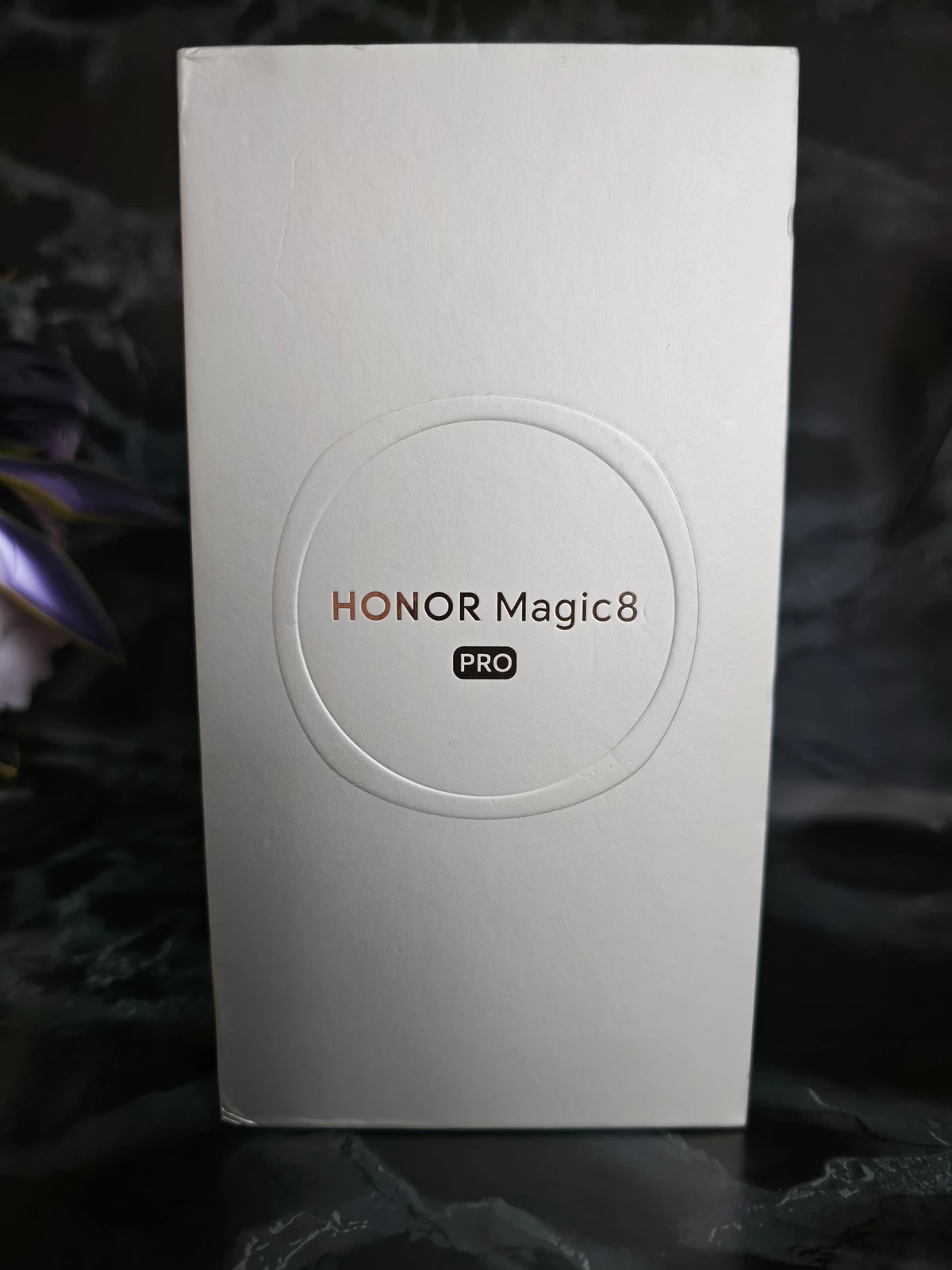
Flagship smartphones have long ceased to be just "the fastest," and now they are required to be the best in literally everything. And, of course, with each passing year, technologies improve, and along with them, the demands on the best of the best grow. So, today we are taking a look at a full-fledged, freshest flagship from Honor — the Magic8 Pro.
Let's start, as usual, with the package contents and appearance.
The smartphone comes in a compact gray box, inside which we find the Honor Magic8 Pro itself, a 100W power adapter for very fast charging, a USB Type-A to Type-C cable, documentation, and a transparent silicone case. The only thing one might nitpick here is the case. It's perfectly fine and has no issues; it's just that with a flagship, you'd expect to see something more premium than a basic silicone case.
Moving on to the smartphone, it's worth noting immediately that the body is made of glass and metal. The body dimensions are 161 x 75 x 8.3 millimeters, but the camera module protrudes more significantly. All this with a weight of 219 grams. The smartphone is superbly assembled and feels monolithic. It's also nice that the frame is flat, while the front and back glasses are "three-dimensional" and curve over the frame. No, there are no "waterfall" edges, just a convex glass.
The front greets us with a 6.71-inch display with a resolution of 2808 x 1256 and a mind-blowing peak brightness of 6000 nits in HDR and 1800 nits in SDR. Of course, it's an OLED panel, and, of course, with LTPO and 120 Hz for maximum smoothness. The screen is absolutely magnificent — colors are bright and saturated, with no hint of color shifting, and the HDR brightness is truly impressive.
In the top part of the screen, we see a small cutout housing two cameras and a sensor array for facial recognition. Yes, Honor remains true to tradition and once again uses not only an under-display fingerprint scanner but also a fully secure facial unlock system that works in absolutely any conditions and is virtually impossible to fool.
Looking at the frame, we see on the right edge a volume rocker, a power button, and a multifunctional button with a touch-sensitive panel, which primarily serves as a shutter button for easier camera use. On the top edge, we see holes for a speaker and an additional microphone, while the bottom edge houses the main microphone hole, another speaker, and the USB Type-C port. Also on the bottom edge is the nano-SIM card slot.
But the star of the show is on the back. The back panel is covered with matte glass, which feels very pleasant to the touch, while the top part features a huge "disc" housing the camera module with three lenses inside and a fourth dummy lens added for symmetry.
Cameras
And, in fact, let's move straight to the cameras. In total, the smartphone has five camera modules, but one of them is not a full-fledged camera and is used for depth sensing (the second one among the front cameras). Here's what's in the main module:
- A 200-megapixel module with f/2.6 aperture, 3.7x optical zoom, and optical image stabilization. This is one of the two Ultra Night modules. The 100x digital zoom also works from here.
- A 50-megapixel main module, also the second Ultra Night module, f/1.6 aperture, optical image stabilization.
- A 50-megapixel module with f/2.0 aperture, a 122-degree field of view, and macro capability from a distance of 2.5 centimeters.
Needless to say, the photo quality is simply excellent? And this holds true for virtually any lighting conditions, which is what you'd expect from a flagship in 2026. You can check out sample photos from different modules in the album below, and there's also a link to a folder with these same photos uncompressed. Video is also great, with hybrid stabilization (optical and digital simultaneously) working during recording. In short, in terms of high-quality materials, build, and flagship cameras, the Honor Magic8 Pro is unequivocally a full-fledged flagship.
Performance
I have the version with 12 GB of RAM and 512 GB of storage, but there is also a variant with 16+1024 GB. Otherwise, these versions are identical, so both feature the Qualcomm Snapdragon 8 Elite Gen 5 processor — the latest top-tier solution from Qualcomm with 8 cores (2 Prime and 6 Performance). The smartphone runs on Android 16 with the proprietary Honor MagicOS 10 skin.
The system operates extremely smoothly without any hint of stutters or lags — everything literally flies. This, however, was expected, and it's more interesting to see how the smartphone handles resource-intensive tasks.
Let's start testing with a small number of synthetic benchmarks.
- Geekbench — 3660/9519
- 3DMark Wildlife Extreme — 70111
- AnTuTu — 4,109,010
And now for games. I'll say right away that I checked not only native Android titles but also a number of games via Switch and PC emulators. All results are in the list below, where I'll also specify the in-game settings. I'll clarify that the results were recorded after half an hour of play — the device was given time to warm up and, if it came to that, start throttling.
- Arknights: Endfield (Max) — 60 FPS
- Genshin Impact (Max) — 60 FPS
- Zenless Zone Zero (Max) — 60 FPS
- Wuthering Waves (Max) — 60 FPS
- Cyberpunk 2077 via Gamehub (720p, Minimum, FSR 2.1 Quality) — 42 FPS
- Tales of Arise via Gamehub (720p, High) — 66 FPS
- Ghost of Tsushima via Gamehub (720p, Low) — 31 FPS
Additional note — in Cyberpunk 2077 and Ghost of Tsushima, there are issues with hardware utilization due to the raw graphics driver in the emulator. The FPS can and should definitely be significantly higher.
If you follow the speed of PC emulation development on Android, you already know it's progressing by leaps and bounds. Therefore, with each new version of the emulators, the performance of such super-powerful smartphones continues to grow due to more efficient use of available resources. For this reason, I wouldn't be surprised if in six months to a year we'll be diving into even very demanding games with maximum comfort right on smartphones.
Battery Life
Another important aspect for a smartphone is battery life, and here Honor hasn't disappointed either.