

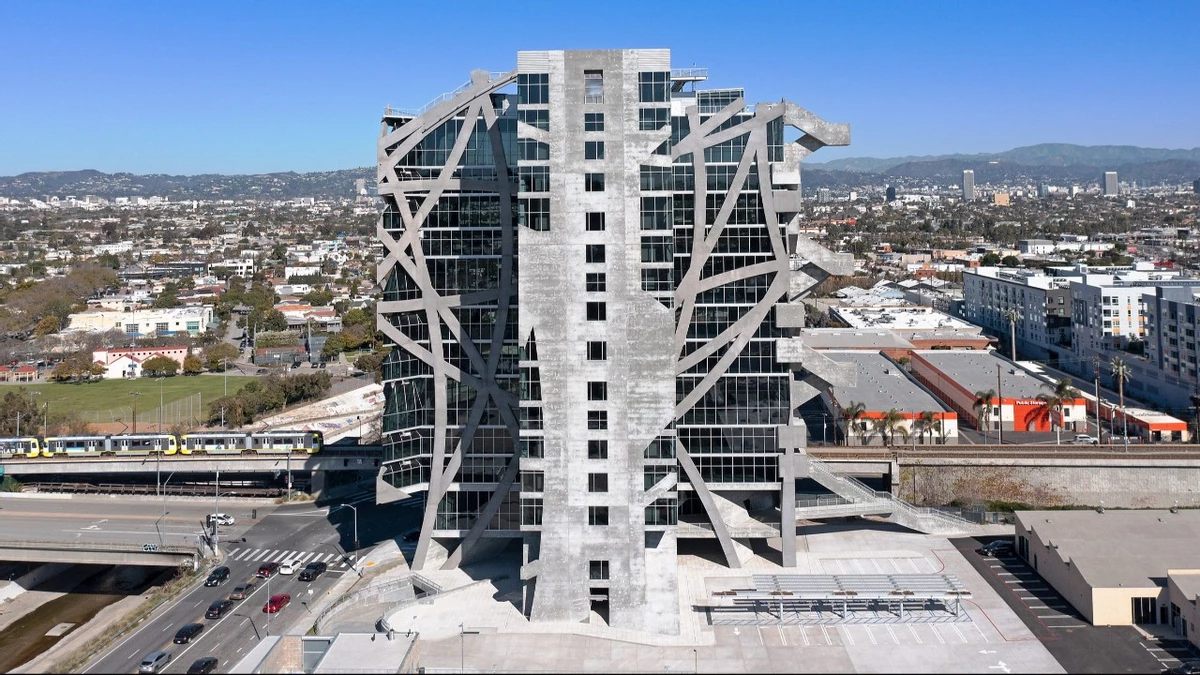
The Vault-Tec Headquarters from the Fallout Series is Not CGI, but a Real Building with Modifications
Observant viewers of the second season of the Fallout series noticed that the headquarters of the Vault-Tec corporation looked suspiciously familiar. As it turns out, the show's creators didn't build a set from scratch or rely entirely on computer graphics—they used a real building, only slightly modifying it with CGI.
This refers to the (W)rapper Tower skyscraper, located in Culver City (essentially within Los Angeles). It is a 17-story office building, 72 meters tall. It was designed by architect Eric Owen Moss and opened in 2023.
The building's name is a reference to the word "wrapper" and reflects its main architectural feature: the facade is encircled by massive, curvilinear steel bands. They wrap around the building's corners and descend to the foundation. Each "wrap" reaches one and a half meters in height and is about 30 centimeters thick; the surface is covered with fireproof plaster.
The (W)rapper's design fundamentally differs from traditional skyscrapers. Instead of columns on a modular grid, the building is supported by a network of curved bands emanating from several geometric centers. An external staircase, made from the same materials, complements the look: it zigzags up one side of the facade, seamlessly merging with the structural frame.
It is this unusual, almost futuristic aesthetic that made the (W)rapper the perfect candidate for the role of the villain's headquarters in the dystopian world of Fallout. The building fit so organically into Vault-Tec's visual style that many viewers initially didn't realize its real-world origins.
It is the only commercial skyscraper in the USA with a seismic isolation system. The steel bands rest on an isolated foundation that separates the tower from the ground. This allows the building to move safely during an earthquake.