

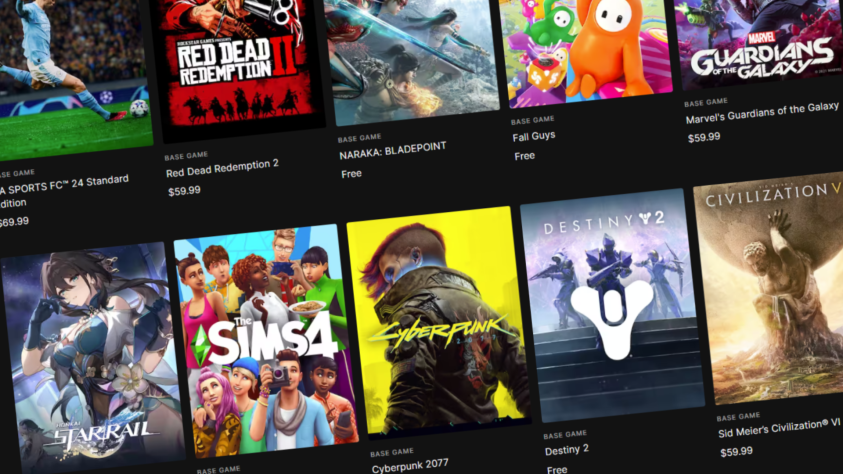
"Our Launcher Sucks" — Epic Games Store Boss on the Service's State and Improvement Plans
Epic Games Store Vice President Steven Allison spoke bluntly about the state of the launcher and promised major changes this year. In an interview with Eurogamer, he frankly admitted: the client is slow and has long irritated users, and Epic has delayed working on user convenience for too long.
The conversation was prompted by the annual Epic Games Store report. The company talked about increased spending on third-party projects while simultaneously confirming a drop in playtime for Fortnite. However, Epic's main focus was not on numbers, but on the store's future.
According to Allison, in 2025 the team finally shifted its focus from developer tools to user convenience.
Last year we rolled out a bunch of stuff, and this year will likely be the best for working on the so-called 'big rocks.' And the 'big rocks' are: our launcher sucks. Let's call it what it is. It's damn slow. Steven Allison
Allison named the Epic Games Store launcher's speed as the main problem. The client constantly contacts the server with every click, causing the interface to "think" for several seconds. Epic began restructuring the architecture in November 2025 and has already "ripped out the old guts to put in new ones." According to Allison, the first results should be noticeable to players in May or June, and Epic's official plans mention "this summer."
In addition to speeding up the launcher, Epic plans to add social features that the store has long lacked. The service will get avatars, user profiles, private messages, and cross-platform text chat. Voice chat support will start in May. In the fall, the company will launch a unified library for PC and mobile devices, update game collection management, and introduce regional storefronts. Separately, Epic is preparing to release the store on iOS in Japan in March and in Brazil in June.
The Eurogamer journalist asked Allison a very reasonable question — why a company with such huge resources took so long to implement basic store features. According to the Epic boss, the issue lies in the complexity of the model itself. Epic Games Store was initially built as a "two-sided marketplace," and at the start, this turned out to be much harder than expected.
The store gained an audience very quickly — about 30 million users in the first 14 months. In such a situation, Epic decided to focus on attracting publishers and developers. The company needed to simplify their entry into the ecosystem and create convenient tools so developers wouldn't have to do everything manually. Free giveaways helped attract players and balance the interests of both sides.
Allison also reminded that the store was launched as a tool to pressure the market. Epic wanted to offer developers better terms — an 88/12 revenue split instead of the usual 70/30 on Steam. This goal remained a priority for a long time, while user features took a back seat.
Now the priorities have changed. Epic is directing most of its efforts toward player features and does not argue with the criticism. Allison acknowledged that part of the audience still views the company very negatively.
All that criticism is fair [criticism from the r/fuckepic subreddit]. There are people who feel exactly that way about us, and we respect that. But we know: when these features arrive, players will be happy, we just need to get it done.
I hope that in a couple of years we won't be having this conversation anymore. Cross-platform capabilities are cool, and the social features might even be better than anyone else's. The goal for that timeframe is for Epic to no longer look like it's lagging behind in terms of expected features.
We're trying to address all the major and fair complaints. We just need to sit down and do the work. Steven Allison