

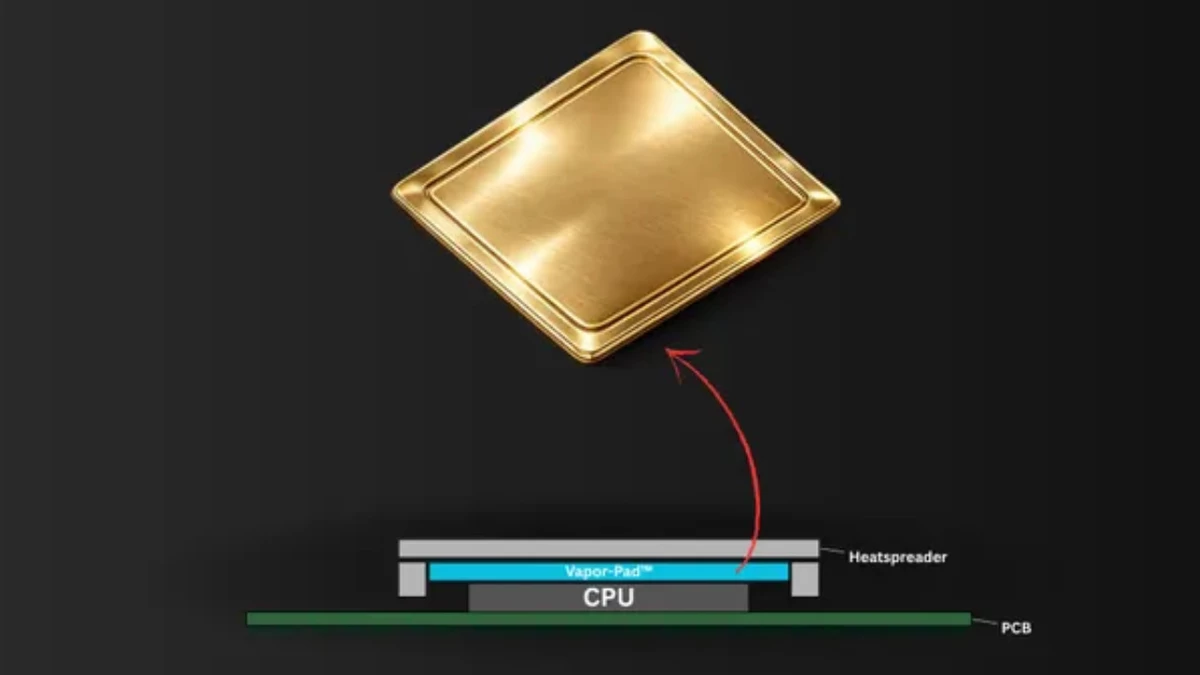
At MWC 2026, Xerendipity put forward a cooling concept for small-form-factor devices that reads like a jump in scale rather than an incremental tweak. Their new Vapor-Pad is quoted at roughly 800–1200 W/m·K. To put that beside familiar numbers: consumer-grade thermal pads sit around 15–20 W/m·K, while pure copper is on the order of ~400 W/m·K — so the claimed figure is striking and, frankly, begs closer inspection of how those numbers were obtained.
The company points to a hybrid approach as the explanation: think of an ultra-thin vapor chamber built into the body of a soft thermal pad — a sub-mm vapor chamber wrapped in a compliant TIM. This is presented as a direct-fit option between a processor die (CPU/SoC) and the IHS, intended to replace solder or thermal paste; whether that swap plays well with manufacturing, rework, and long-term contact pressure is left open. Alongside the Vapor-Pad, Xerendipity showed a Non-Metal Vapor Chamber (NVMC) family aimed at smartphones — non-metal vapor chambers designed for tight stacks and mobile SoC cooling. The demos are intriguing; the real questions are about test conditions, durability, and how this integrates into existing thermal stacks.