

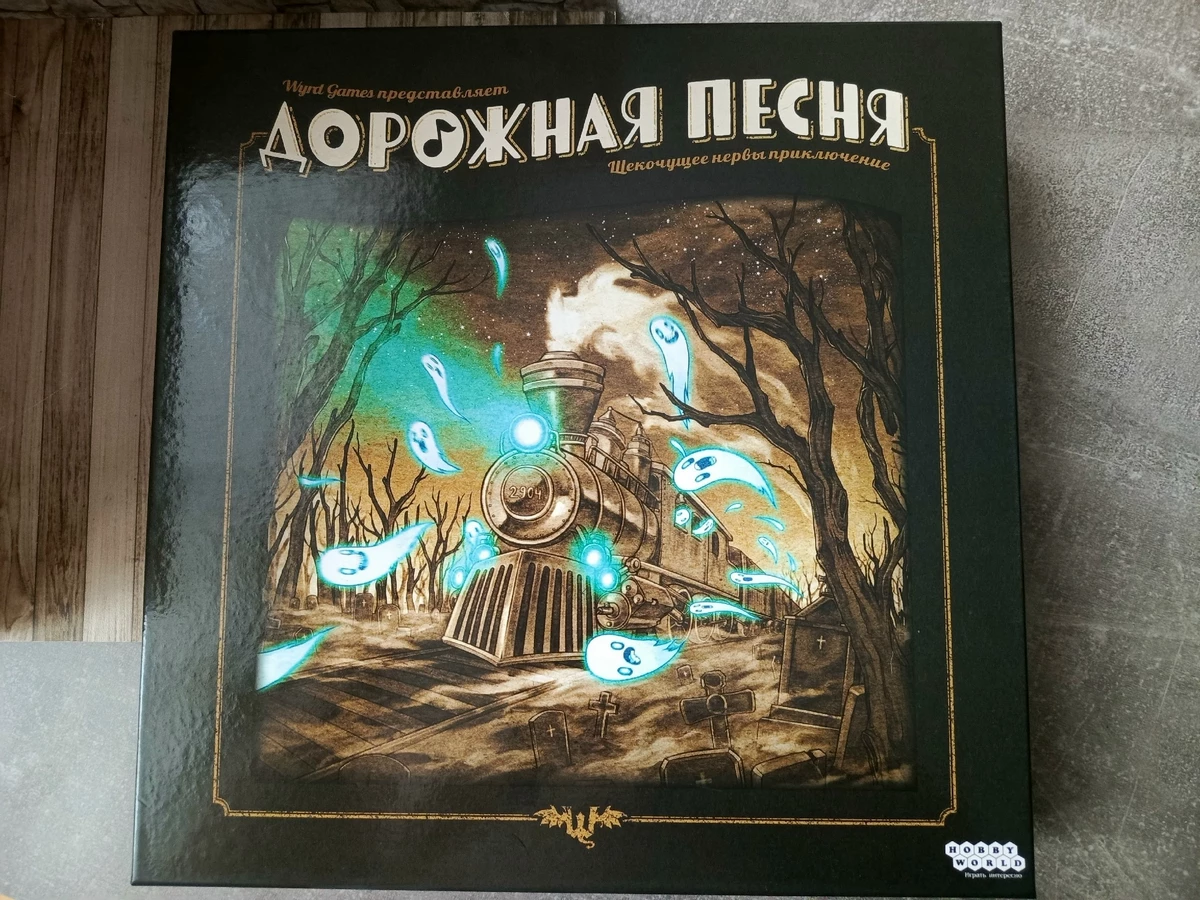
Board Game "Road Song" – Ghost Hunters on a Victorian Train
But before diving into the rules, let's take a peek inside the box.
What's in the Box?
On the cover, we see the key components:
- The train board;
- A drawstring bag;
- 6 dice (d6);
- 7 Vagrant miniatures with bases;
- 20 Ghost miniatures with bases;
- Over 240 cards;
- Around 100 tokens, markers, and counters;
- Scenario book;
- Rulebook.
The set is quite hefty – 2.39 kilograms.
What the Game is About and How to Play
The gameplay revolves around a system of three coins that each Vagrant receives at the start of their turn and spends on actions. You can move orthogonally (distance depends on speed and coins spent), rummage in the drawstring bag for items, investigate events on the board, heal wounds, or attack Haintim. Almost all actions, except movement and rummaging, require dice rolls: success is counted by exceeding the corresponding characteristic, and a roll of six grants an additional die. Each character has up to four skills, but most cannot be used two turns in a row.
The turn order for players is freeform, allowing for flexible coordination of efforts. After each Vagrant's turn, the Haintim activates: a token is drawn from the same bag, determining the action, movement, and target according to a strict priority. Ghosts have two moods, which change during play and significantly influence their behavior. Many Haintim pass through characters, inflicting Corruption with unique long-term consequences. The board features a Cycle track: accumulated tokens, upon reaching a type-specific limit, trigger a powerful negative effect specific to the scenario, forcing players to think ahead about resource expenditure.
Scenario Structure
Typically, a scenario in the board game "Road Song" consists of three train cars with a boss at the end. Besides direct attacks, you can perform rituals: collect key items, reunite memory fragments, find a hat or a bear, or perform special actions to gently restore a ghost's humanity. Investigating events provides clues, bonuses, and sometimes a direct advantage in combat. The duration of one scenario is approximately 30–90 minutes, depending on the number of players and experience.
Atmosphere and Artwork
The atmosphere permeates everything: dark humor, sharp and eerie texts, purgatory mysticism, rubber-hose stylistics of the 1920s-30s, and magnificent artistic design. The acrylic miniatures look stunning, and the components are generally of high quality, though bases are sometimes insufficient, and cards might stick together during the first play. Theme and mechanics are in rare harmony: the chaos of dice rolls, the risk of possession, the constant threat of losing a character create tension where euphoria can plummet into despair in a second. Each Haintim is a separate tragic sketch of a lost soul, and while the overall story arc remains mysterious, it's these little stories and hints of the past that make you come back for more.
Strengths
The coin system provides instant tactical depth: where to invest resources, who to cover, whether to risk everything on an attack or heal and search for items first – the decisions become very rich. The uniqueness of each boss, mood shifts, rituals, and cycle effects offer high replayability and a sense of freshness even after several scenarios.
Weaknesses and Difficulties
The main problems arise not from the mechanics, but from the rules. The booklet is overloaded with details, important clarifications are scattered across different sections, and some limitations are easy to miss. The organization of information in the book is inconvenient: for a single Haintim, you have to flip through several pages. The randomness of dice rolls and draws can lead to significant frustration, especially when everything goes wrong.
Verdict
Board Game