

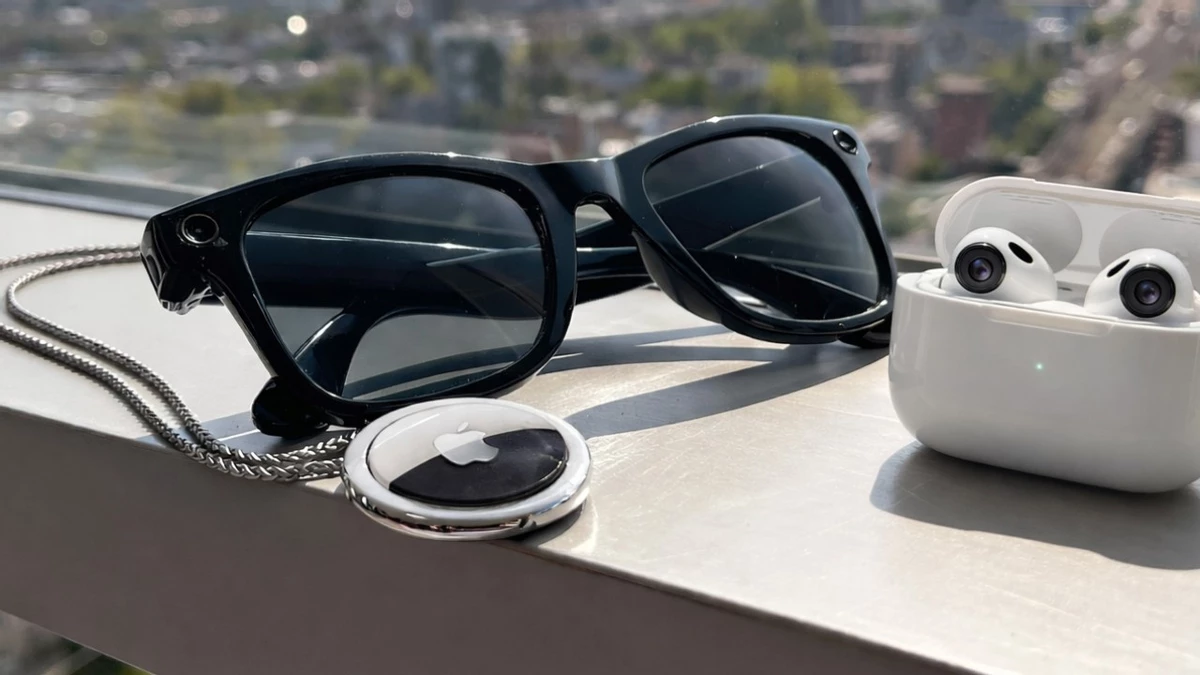
Apple Ramps Up Work on Wearable AI Devices
Glasses, Pendant, and Updated AirPods
According to Bloomberg columnist Mark Gurman, Apple is actively developing three innovative wearable devices with artificial intelligence support — smart glasses, a compact "smart pendant," and upgraded AirPods headphones. All gadgets will be tightly integrated with the iPhone and a new version of the voice assistant Siri, which will gain enhanced capabilities for processing visual context.
The main project in this lineup is considered to be smart glasses. Unlike many augmented reality counterparts, the device will not have a built-in display — control is expected to be primarily through voice commands using Siri. At the same time, the glasses will feature a high-resolution camera, an additional sensor for analyzing the environment (operating on a principle similar to LiDAR in the iPhone), as well as microphones and speakers. With their help, users will be able to make calls, listen to music, ask questions about their surroundings — for example, find out the composition of a dish, translate text from signs, or get information about landmarks. Furthermore, the ability to create contextual reminders will be added. Production of the glasses could start by the end of 2026, with their official release planned for 2027. Notably, Apple is developing the frames independently, without involving third-party brands.
The second device is a compact gadget the size of an AirTag, which can be worn as a pendant or attached to clothing. It will be equipped with a low-resolution camera, a microphone for calling Siri, and its own chip. The pendant will serve as the smartphone's "eyes and ears": constantly scanning the surroundings and transmitting data to the iPhone so Siri can provide contextual hints. The main computational load will fall on the smartphone. The device's release is also expected in 2027.
The third project is upgraded AirPods, which are planned to integrate low-resolution cameras. Their task is not to take photos or videos, but to collect data for the artificial intelligence's operation. Among the expected functions are adapting spatial audio to the room's acoustics, for example, amplifying the voice of an interlocutor in a noisy environment. Gesture recognition is also planned, such as touching the ear to pause or turning the head to switch tracks. Additionally, a real-time speech translation mode may appear in the headphones. The release of the updated AirPods is possible as early as 2026.
All three devices reflect Apple's ambition to turn Siri into a full-fledged AI companion capable of "seeing" the surrounding world and reacting to it. The cameras in the gadgets are not for creating media content, but for analyzing space and context, which will allow the assistant to better understand the situation and suggest appropriate actions. The company is betting on convenience and practicality: the devices should be lightweight, compact, and have long battery life.